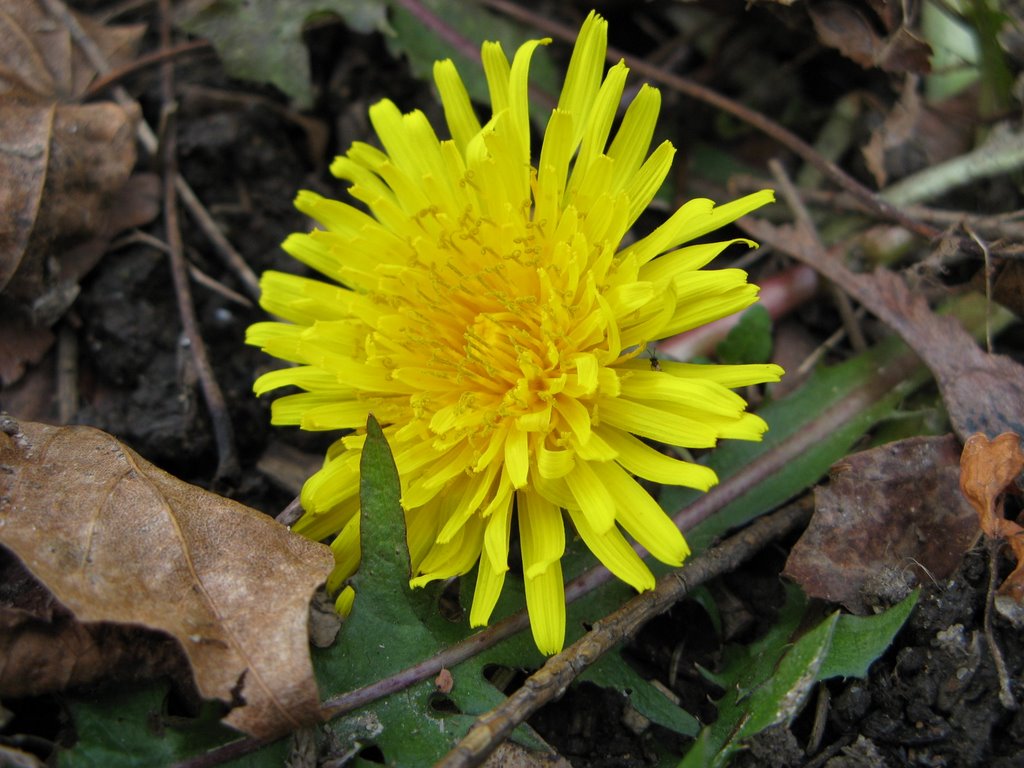
 We've had such a warm fall here in Massachusetts. I just noticed this dandelion blooming in my front yard and it actually looks like the grass needs cutting. It's practically December!
Just a few weeks ago I brought this geranium inside to winter over. I probably could have left it outside if I had covered it on frosty nights. There really hasn't been a hard sustained frost yet. My rosemary and sage are still hanging on.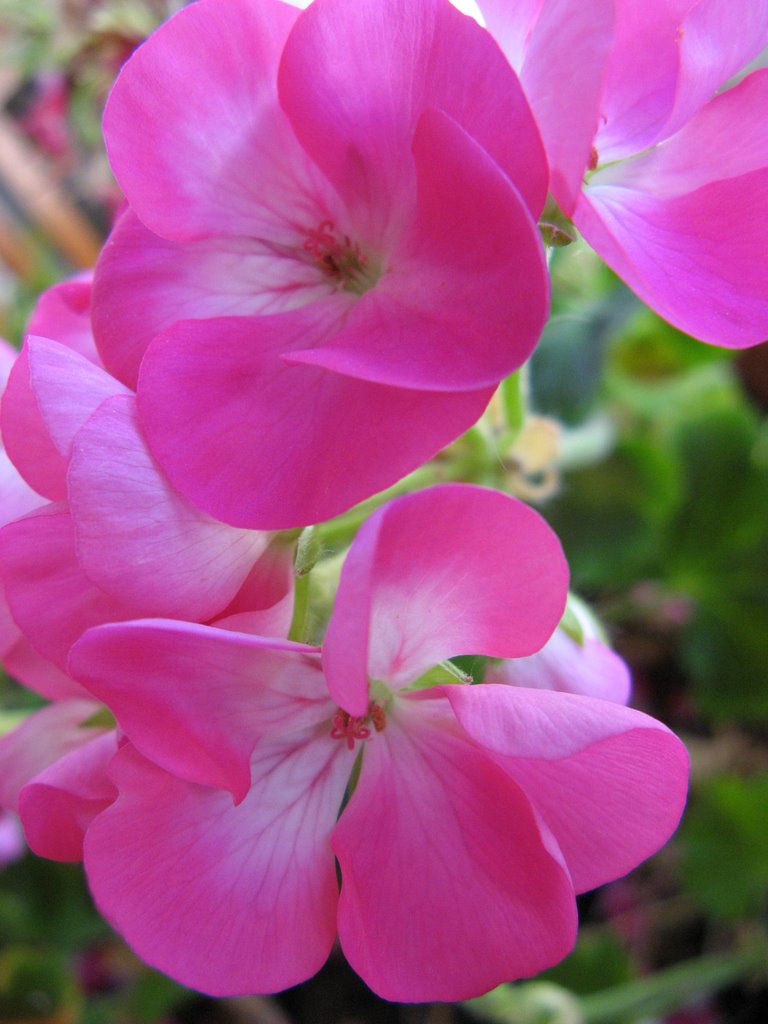
Tuesday, November 28, 2006
Warm Fall


Sunday, November 26, 2006
Chicken Butchering - Part 1 - Prep
As you may remember from earlier posts, I'm involved in a pastured poultry project at Codman Farm. We are raising some White Rock chickens out on pasture. They spend their days outside in the cow pasture and at night they go into the mobile coop to sleep and be safe from owls and other flying predators. Ground predators are stopped by the portable electric fence that surrounds them. Every few days the mobile coop is moved to a new area so they can have fresh pasture.
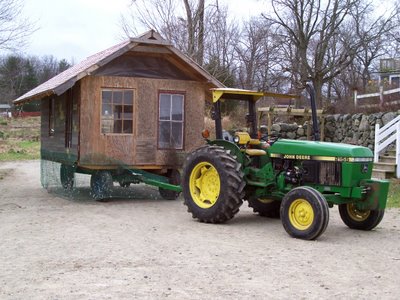
Last Monday was butchering day. The first step started the day before. Instead of giving the chickens their usual afternoon feed and water, they are only given water. Essentially they are on a clear liquid diet for the 12 hours before butchering. This insures that there is little or no food in their digestive tract. That will make an easier and cleaner job the next day. The next morning they are brought to the area where we will kill and butcher them. Because they sleep in the mobile coop, this job is very easy and does not involve chasing or catching or stressing the chickens. Heidi drove the tractor to the field, hooked up the mobile coop, and towed them back. It's a really simple way to "round up" 124 chickens.
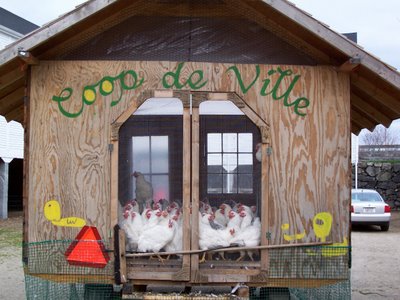
 From the other side of the coop you see can the chickens all at the anxious to get out. It is a simple matter to open the door and take one out at a time to butcher. One feature of the mobile coop that you can not see from the picture is that the floor boards are spaced so that much of the manure falls out. This means that the coop doesn't need constant cleaning. The manure that falls fertilizes the cow pasture.
 NOTE: I'm wondering if this chicken butchering series is going to bother anyone. I plan to indicate in the title what will be covered and have some text before the pictures so people have a chance to leave if they don't want to look at the pictures. What does everyone think? I really don't want to upset upset someone who is unprepared. For those of you who are really interested in the process, another blogger has created a really great video clip of the process which you can see here.
Last Monday was butchering day. The first step started the day before. Instead of giving the chickens their usual afternoon feed and water, they are only given water. Essentially they are on a clear liquid diet for the 12 hours before butchering. This insures that there is little or no food in their digestive tract. That will make an easier and cleaner job the next day. The next morning they are brought to the area where we will kill and butcher them. Because they sleep in the mobile coop, this job is very easy and does not involve chasing or catching or stressing the chickens. Heidi drove the tractor to the field, hooked up the mobile coop, and towed them back. It's a really simple way to "round up" 124 chickens.
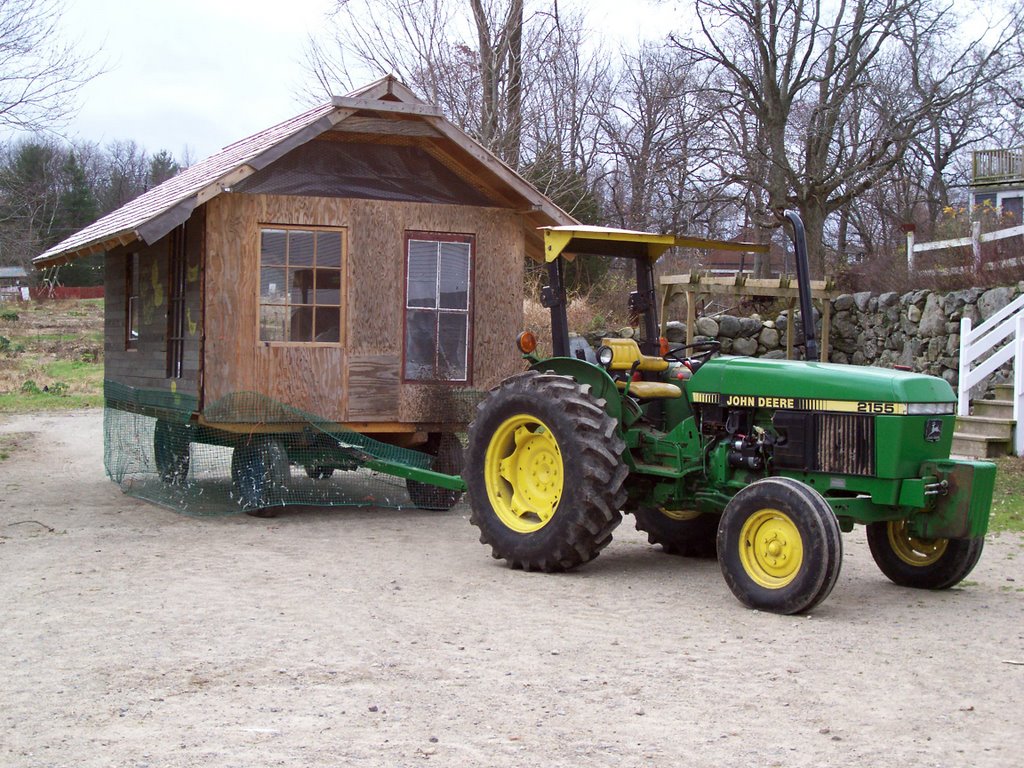 From the other side of the coop you see can the chickens all at the anxious to get out. It is a simple matter to open the door and take one out at a time to butcher. One feature of the mobile coop that you can not see from the picture is that the floor boards are spaced so that much of the manure falls out. This means that the coop doesn't need constant cleaning. The manure that falls fertilizes the cow pasture.
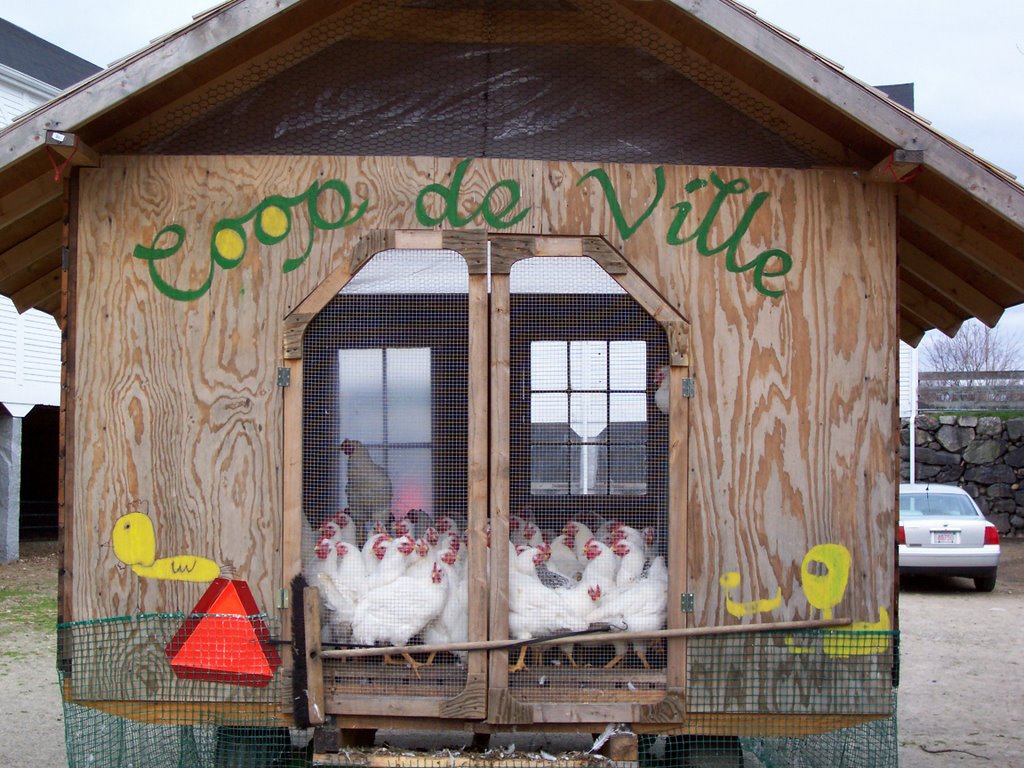 NOTE: I'm wondering if this chicken butchering series is going to bother anyone. I plan to indicate in the title what will be covered and have some text before the pictures so people have a chance to leave if they don't want to look at the pictures. What does everyone think? I really don't want to upset upset someone who is unprepared. For those of you who are really interested in the process, another blogger has created a really great video clip of the process which you can see here.
Friday, November 24, 2006
Thanksgiving Squash

Thanks to Helen of Beyond Salmon for giving me an idea of what to do with the delicata squash that I grew this summer. I made a variation of her recipe for Thanksgiving dinner.
Sunday, November 12, 2006
I'm Still Here - New Camera on the Way
 Wow It's hard to believe it's been almost a month since I posted. I've finally ordered a new camera to replace my old one that bit the dust. I've borrowed a camera in the mean time, but it's just no fun using it and I don't like posting without a photo. I've decided on a Canon Powershot A710 to replace my Nikon Coolpix 950 that I did love despite the fact that it was a 2 megapixel camera and quite old. I should have the new one in about 1o days.
In the mean time, here are some photos of sunflowers. Where I plant my vegetable garden, sunflowers grow wild and I always leave or transplant one or more to act as "poles" for something climbing. Last year I grew Romano pole beans on some sunflowers and this year I grew yardlong beans one sunflower stalk. When the sunflower is a few feet tall I pinch the ends to make it branch to give the beans more places to climb. As the beans grow up the plant I also pull off as many leaves from the sunflower plant as I can without killing it. This is to let more light in. This was my first year growing yard long beans. I didn't like the taste as much as regular string beans, but I did like it enough to grow them again. Each beanpod is about 18 inches long . That makes harvesting go really quickly.
 If you click on the photo for a larger image, you can see some of the yardlong beans hanging on the right side of the plant.
Friday, October 13, 2006
Chickens on Pasture
 finally, a few weeks ago the broiler chicks were moved out to the pasture. They are locked up in the mobile coop at night for protection and let out during the day. They are surrounded by electric fencing to protect them from predators or overly curious cows with whom they are sharing a pasture. The vast majority of chickens raised in our country never even go out of doors for their entire lives and live in very crowded conditions. I'm so happy to be raising my meat in a healthier and more humane way. People ask me how I can butcher and eat something I helped raise myself. These same people eat supermarket chicken with no qualms.
Tuesday, September 26, 2006
How to Weigh a Chicken - The Easy Way
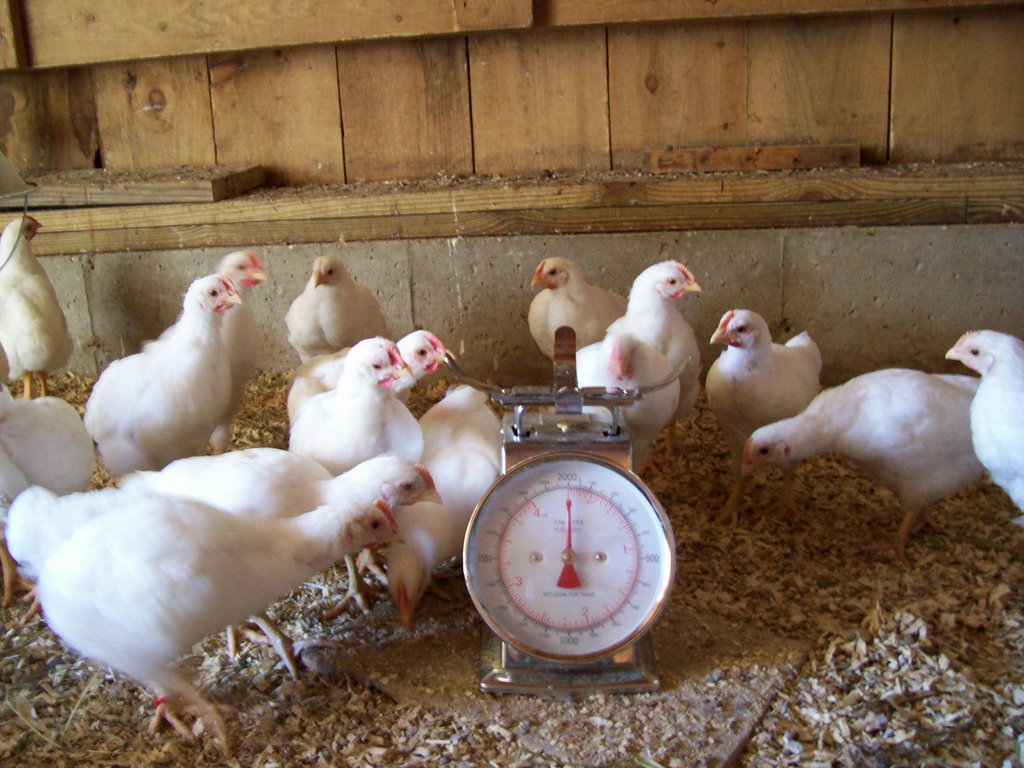 Before today, each week I used to catch some of the chicks, put them in a cardboard box and weigh them and record the average weight. Today I couldn't find the cardboard box. The chickens showed me a much easier way to weigh them. Less than 30 seconds after putting the scale down, a little rooster would jump up and weigh himself. I'd record his weight, shoo him off and wait for the next one to jump on. I weighed three of them today this way. The average weight of these White Rocks rooster chicks was 1 pound 5.7 ounces. They are 6 weeks old.
Tuesday, September 12, 2006
Little Cottage?

Camera angle can mean so much. What appears to be a little country cottage is really an A-frame pig shed. The other side of the fence is mostly mud with a couple of very pregnant Tamworth sows wallowing in it. If my camera had not broken, I was going to take a photo from the other direction. This is one of the perennial plots (not mine) where I have my community garden at Codman Farm in Lincoln, Massachusetts, USA.
Chick update: At 4 weeks old today, the White Rock Roosters weighed an average of a little over 10 oz. each.
Note. My camera (Nikon Coolpix 950) broke! I don't have time to investigate or buy one before my daughters wedding. Any thoughts on what you love or hate about the camera you use would be appreciated for when I start the camera buying process. In the mean time no more baby chick update photos.
Tuesday, September 05, 2006
Okra
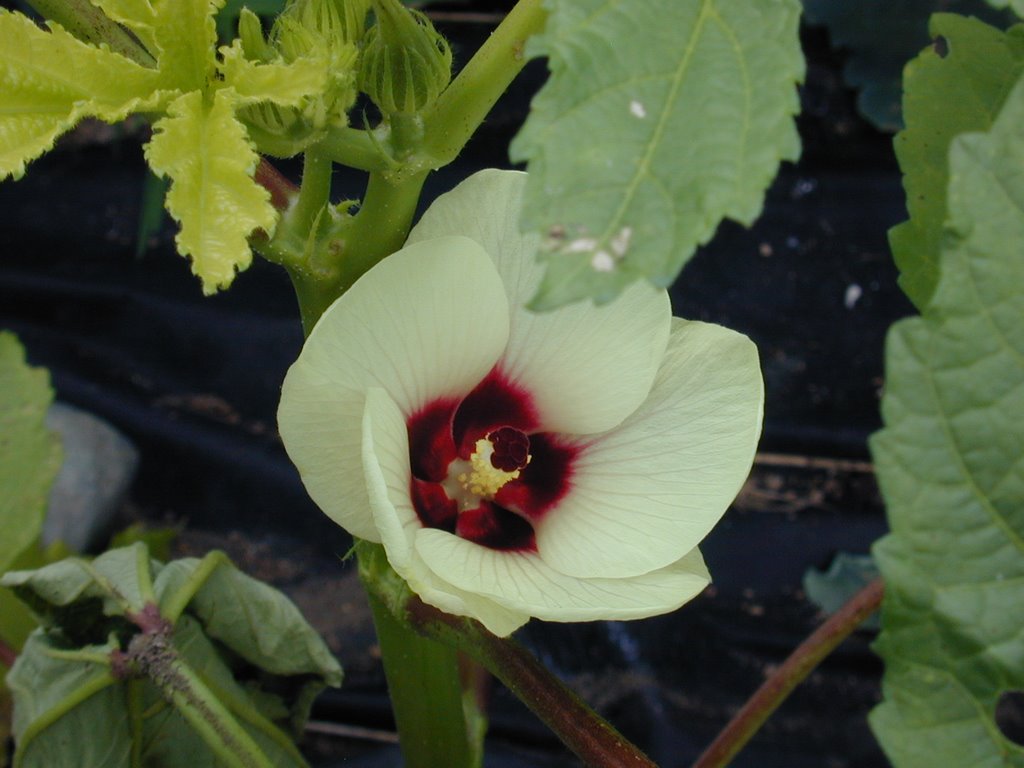 I like okra a lot. I love the taste and I think its tropical looking flower is beautiful. It's not exactly a staple of a typical New England diet and I often meet people who have never eaten it. It's not consistently available here in the market so I try to grow it. During our very cool very wet spring this year, I had to seed it three times before I was successful. I sowed it once inside in pots where it failed and twice outside. I was successful the second time outside. What I've learned is it seems to need lots of warmth which is not surprising because it's native to Africa. I've found it needs warmth even more than tomatoes or peppers do. Now that cooler September weather has arrived I fear it will soon stop producing. It's produces enough to eat or add to soup occasionally, but I wish I had enough to freeze. My plan for next year is to try and start it again inside, but I'm planning on adding a propagation mat to my collection of garden toys and hope that I will have more success starting it inside and unless it's really hot, I'll probably wait an extra week after Memorial Day before setting it out.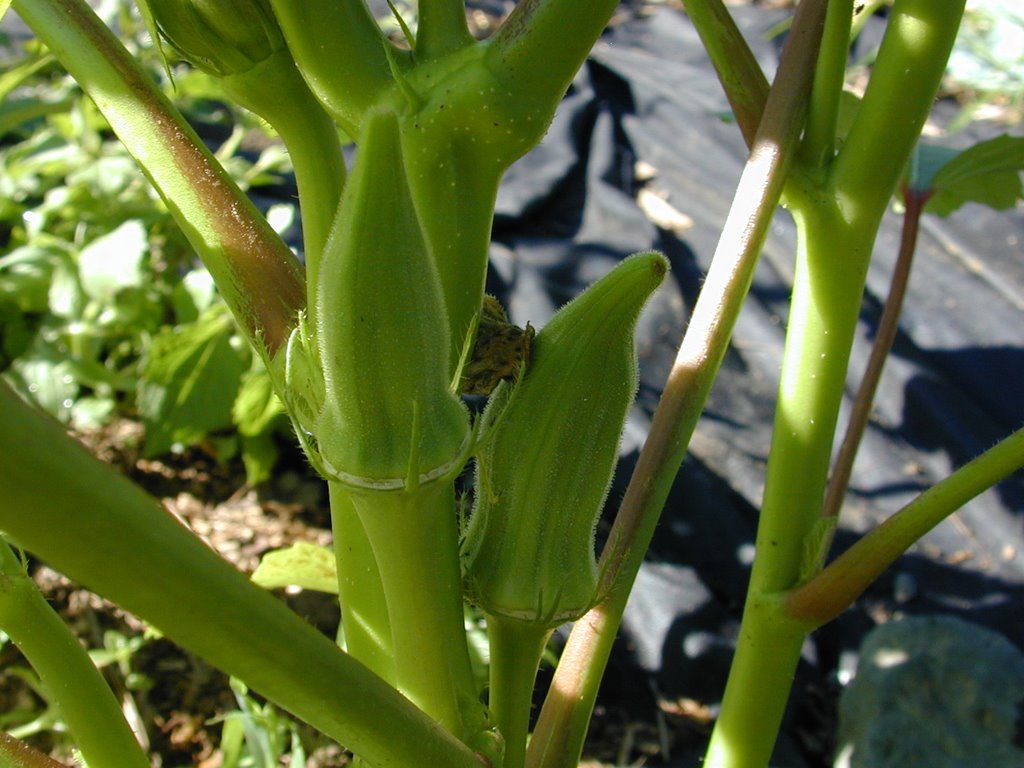
Saturday, September 02, 2006
Chicks 18 days old
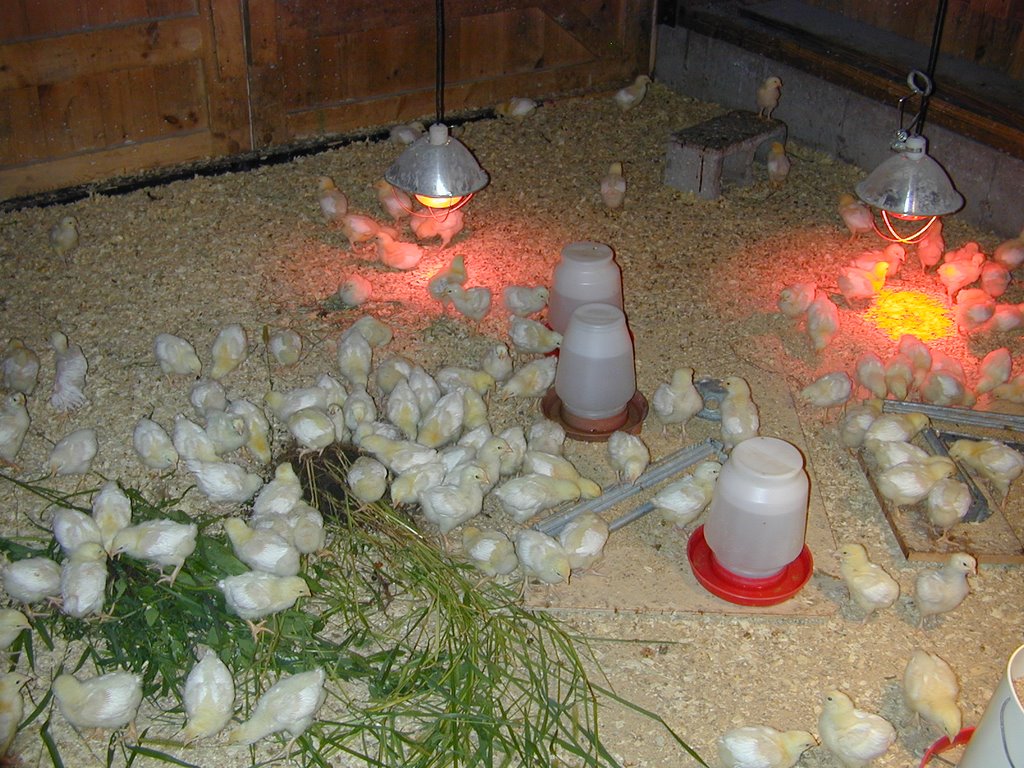 The chicks are now 18 days old. They aren't old enough to go out on pasture yet, so we pull weeds from the garden and to give to them. They really love them and even eat the dirt. You can see in the photo below that they are starting to get their wing feathers.
Friday, September 01, 2006
White Rock Chicks
[[[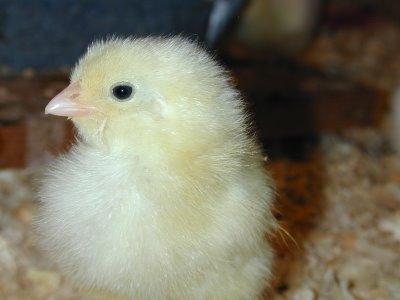 Sorry for the lack of posts. Things are busy in the garden, at work and most importantly I’ve been involved with my daughter’s wedding plans. The wedding will be in a couple of weeks and things are getting a bit hectic here.
After some hatchery and post office delays the chicks finally arrived two weeks ago... They are 125 White Rock rooster but a few seem to be something different. They are in a room in the barn that’s about 11 x 11 feet square. Chicks need an area where the temperatures are 90 degrees in part of the area the first week and can tolerate the temperature to be lowered 5 degrees each week for the first 6 weeks. To provide this temperature there are two heat lamps hanging in their enclosed area. They can self adjust their temperature by moving closer or further form the lamps. The chicks were two weeks old on last Tuesday.
Each week I plan to weigh a sample of the chicks and keep track of their weights. We’re also keeping track of how long it takes them to eat each 50 lbs of feed.
So far the weights are;
At one week, a sample of 10 weighed an average of 2.05 oz. each
At two weeks, a sample of 10 weighed an average of 4.45 oz each
From the weights you can see they more than doubled their weight during their second week.
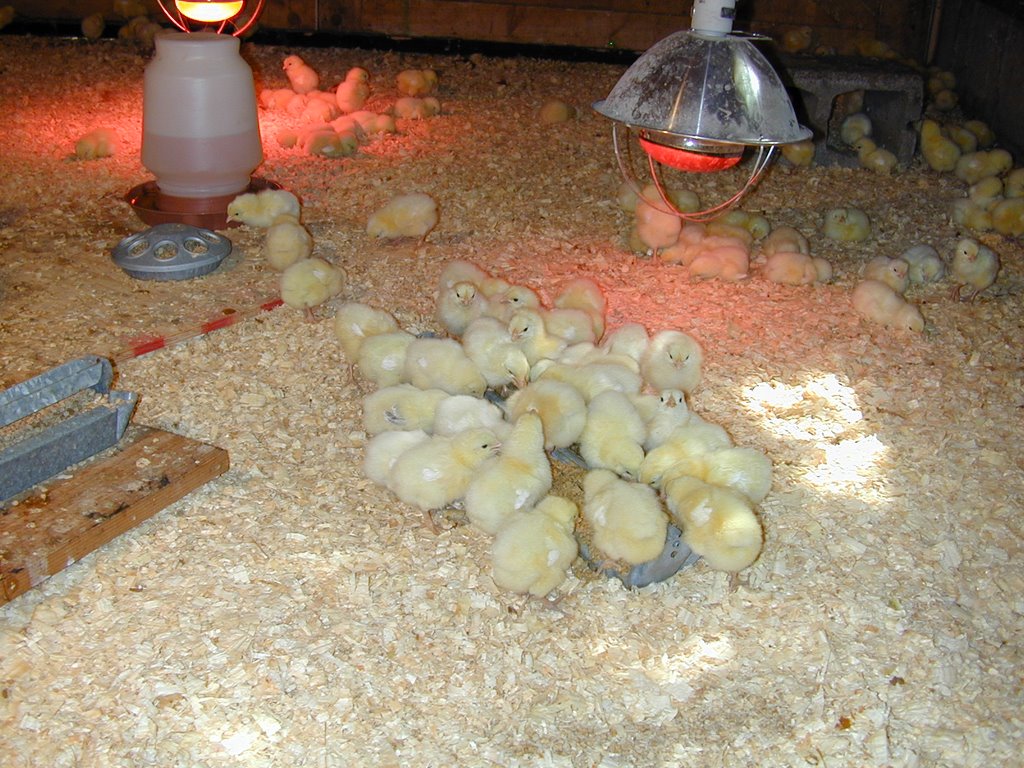
I intended to take a photo of them today and brought my camera to the farm. Unfortunately I forgot to put the memory card back into the camera before I brought it with me. This photo from the first week will have to do for now.
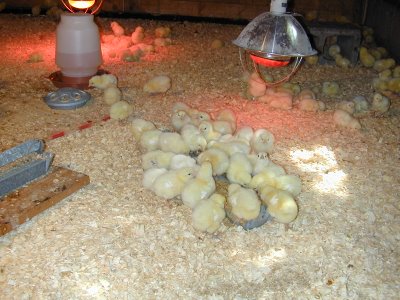
 Sorry for the lack of posts. Things are busy in the garden, at work and most importantly I’ve been involved with my daughter’s wedding plans. The wedding will be in a couple of weeks and things are getting a bit hectic here.
After some hatchery and post office delays the chicks finally arrived two weeks ago... They are 125 White Rock rooster but a few seem to be something different. They are in a room in the barn that’s about 11 x 11 feet square. Chicks need an area where the temperatures are 90 degrees in part of the area the first week and can tolerate the temperature to be lowered 5 degrees each week for the first 6 weeks. To provide this temperature there are two heat lamps hanging in their enclosed area. They can self adjust their temperature by moving closer or further form the lamps. The chicks were two weeks old on last Tuesday.
Each week I plan to weigh a sample of the chicks and keep track of their weights. We’re also keeping track of how long it takes them to eat each 50 lbs of feed.
So far the weights are;
At one week, a sample of 10 weighed an average of 2.05 oz. each
At two weeks, a sample of 10 weighed an average of 4.45 oz each
From the weights you can see they more than doubled their weight during their second week.
I intended to take a photo of them today and brought my camera to the farm. Unfortunately I forgot to put the memory card back into the camera before I brought it with me. This photo from the first week will have to do for now.
Thursday, August 10, 2006
Pastured Poultry - The Pen
One obvious problem being an urban agrarian is the lack of land. I squeeze what I can into my small suburban yard, grow plants where there’s a little sun, keep 4 laying hens and have a large community garden plot further out towards the country. Raising broiling chickens to fill my freezer would seem be out of the question. However, this will be the third year that I will be doing it. It requires finding a willing partner with some land. During the last two summers my friend Farmer Judy and I raised broiler chickens. The first year we raised 25 and the second year we raised 175 split between two batches of 75 and 100. I kept them for the first three weeks while they were in the brooder and then they went to her farm in southern Vermont for the next five weeks. The following year we raised 175 in two batches of 75 and 100 each. Judy won’t be doing it this year so I asked at the farm where I have my community garden, if I could raise broilers on my community garden plot. The answer was no, but one of the farm managers, Heidi was going to do pastured poultry and I discovered I could add my 25 into her batch and we would do them together. This was even better because figuring out how to make a coop or pen that I could transport to my garden plot would have been a challenge.
I’m hoping to chronicle my experiences and thoughts raising broiler chickens this year and over the last two years in a series of posts over the next few months. I plan on covering everything from brooding to butchering.
Once chicks are a few weeks old they do not need the extra heat supplied by their mothers or heat lamps and can go outdoors. For the most part commercially raised meat chickens never have the opportunity to ever be outside. They spend their entire lives indoors in cramped quarters in broiler houses with tens of thousands of other chickens. This is not the way I want the chickens I eat to be raised. Why I think this is better will be the topic of another post, but today’s post is about the shelter the chickens will have. Even though they roam and forage in the pasture during the day, they need a place that is safe from predators and weather to sleep in at night.
The first year Judy and I did chickens, I built a movable pen. This is a popular was to raise pastured poultry made famous by Joel Salatin. The pen has no floor and is moved to a new area of pasture each day, giving the chickens fresh pasture and leaving the droppings behind to fertilize the pasture. One of the problems with this idea was getting the pen light enough to move, but not so light as to fall apart. I built it 8x8 feet by 2 feet high. Sadly it ended up too heavy for us to move easily on hilly terrain AND it fell apart. It didn’t last long enough to even get a picture of it I then built two smaller pens half the size with the pieces from the broken first pen. That worked as far as the pens being easy to move and light, but we soon decided we didn’t like the pen idea. The pen required moving too frequently and the chickens seemed like they would be better off with more pasture. We started to let the chickens out of the pens during the day and only put then in at night. This seemed to work better and meant that the pens did not require moving as much because the dropping from the chickens during the day were not in the pen, but spread out over the pasture. This system is called day range. Ithe one that I prefer and has worked well for the last two years.
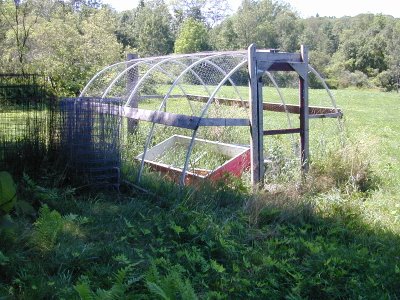
The chickens I am doing with Heidi this year will also be day-ranged. Last year Judy and I built a new pen for the chickens that we think worked well. In this picture it’s missing a tarp that would cover it if there were chickens living it. It’s bottomless and made on wooden runners. It needs a truck to pull it to new pasture space. It was moved about once per week to fresh pasture. By substituting clear plastic for the tarp, this pen can be also be used as a greenhouse to start seedlings in spring. The red thing inside is actually a cold-frame.
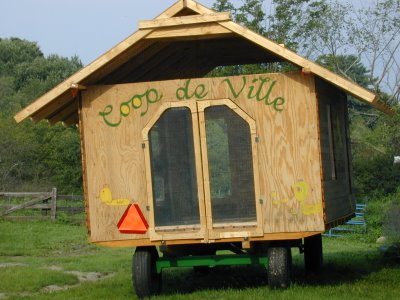
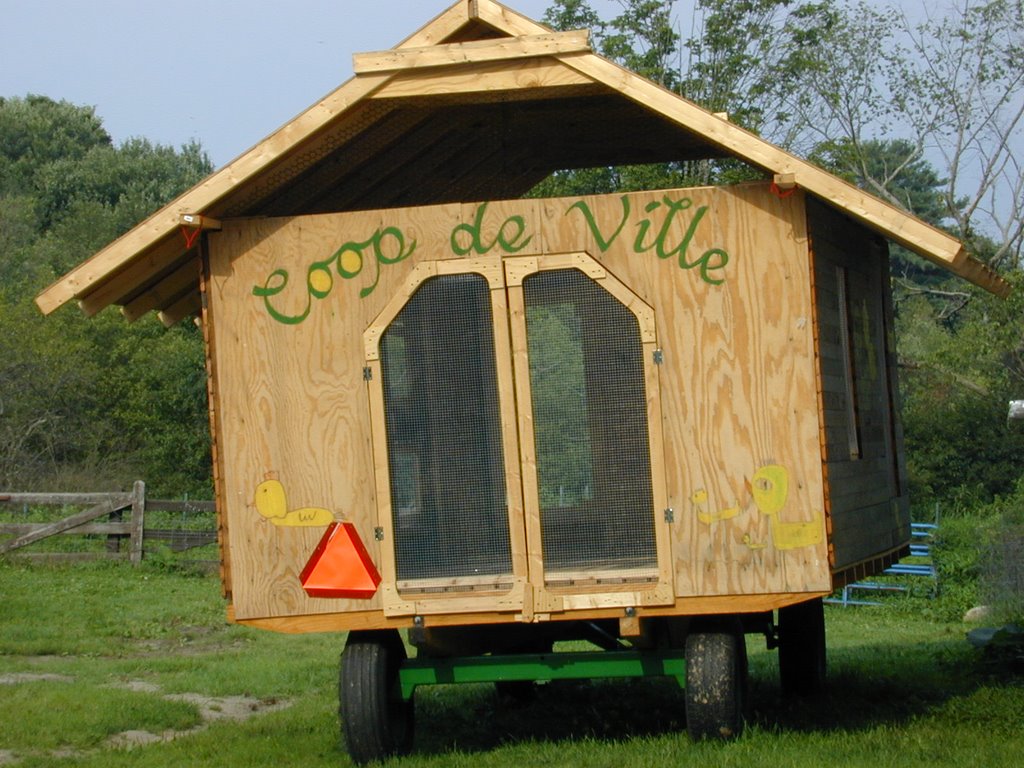
Below is the pen that was built for the chickens Heidi and I will do his year. It’s quite fancy and I heard it won a trophy in the local 4th of July parade. I think it’s solidly built and with its real wheels is very transportable. One change that I think I would have made if it were my pen, is that I would have not built a solid floor. A bottomless pen needs no shoveling out. I think I’d prefer to let gravity do the work of manure spreading. This year’s chicks haven’t arrived yet so I can’t really say how much cleaning out it will need. Things never go exactly as predicted anyway and time will tell what Heidi and I think worked well and what might be changed.
The new chicks are scheduled to arrive this week and I must say I’m excited and look forward to learning more about raising broilers on pasture. They are White Rocks. In the past I raised Cornish Cross chickens and I’m really curious as to the differences between the two breeds.
I’m hoping to chronicle my experiences and thoughts raising broiler chickens this year and over the last two years in a series of posts over the next few months. I plan on covering everything from brooding to butchering.
Once chicks are a few weeks old they do not need the extra heat supplied by their mothers or heat lamps and can go outdoors. For the most part commercially raised meat chickens never have the opportunity to ever be outside. They spend their entire lives indoors in cramped quarters in broiler houses with tens of thousands of other chickens. This is not the way I want the chickens I eat to be raised. Why I think this is better will be the topic of another post, but today’s post is about the shelter the chickens will have. Even though they roam and forage in the pasture during the day, they need a place that is safe from predators and weather to sleep in at night.
The first year Judy and I did chickens, I built a movable pen. This is a popular was to raise pastured poultry made famous by Joel Salatin. The pen has no floor and is moved to a new area of pasture each day, giving the chickens fresh pasture and leaving the droppings behind to fertilize the pasture. One of the problems with this idea was getting the pen light enough to move, but not so light as to fall apart. I built it 8x8 feet by 2 feet high. Sadly it ended up too heavy for us to move easily on hilly terrain AND it fell apart. It didn’t last long enough to even get a picture of it I then built two smaller pens half the size with the pieces from the broken first pen. That worked as far as the pens being easy to move and light, but we soon decided we didn’t like the pen idea. The pen required moving too frequently and the chickens seemed like they would be better off with more pasture. We started to let the chickens out of the pens during the day and only put then in at night. This seemed to work better and meant that the pens did not require moving as much because the dropping from the chickens during the day were not in the pen, but spread out over the pasture. This system is called day range. Ithe one that I prefer and has worked well for the last two years.
The chickens I am doing with Heidi this year will also be day-ranged. Last year Judy and I built a new pen for the chickens that we think worked well. In this picture it’s missing a tarp that would cover it if there were chickens living it. It’s bottomless and made on wooden runners. It needs a truck to pull it to new pasture space. It was moved about once per week to fresh pasture. By substituting clear plastic for the tarp, this pen can be also be used as a greenhouse to start seedlings in spring. The red thing inside is actually a cold-frame.

Below is the pen that was built for the chickens Heidi and I will do his year. It’s quite fancy and I heard it won a trophy in the local 4th of July parade. I think it’s solidly built and with its real wheels is very transportable. One change that I think I would have made if it were my pen, is that I would have not built a solid floor. A bottomless pen needs no shoveling out. I think I’d prefer to let gravity do the work of manure spreading. This year’s chicks haven’t arrived yet so I can’t really say how much cleaning out it will need. Things never go exactly as predicted anyway and time will tell what Heidi and I think worked well and what might be changed.
The new chicks are scheduled to arrive this week and I must say I’m excited and look forward to learning more about raising broilers on pasture. They are White Rocks. In the past I raised Cornish Cross chickens and I’m really curious as to the differences between the two breeds.
Wednesday, August 09, 2006
Tomatoes
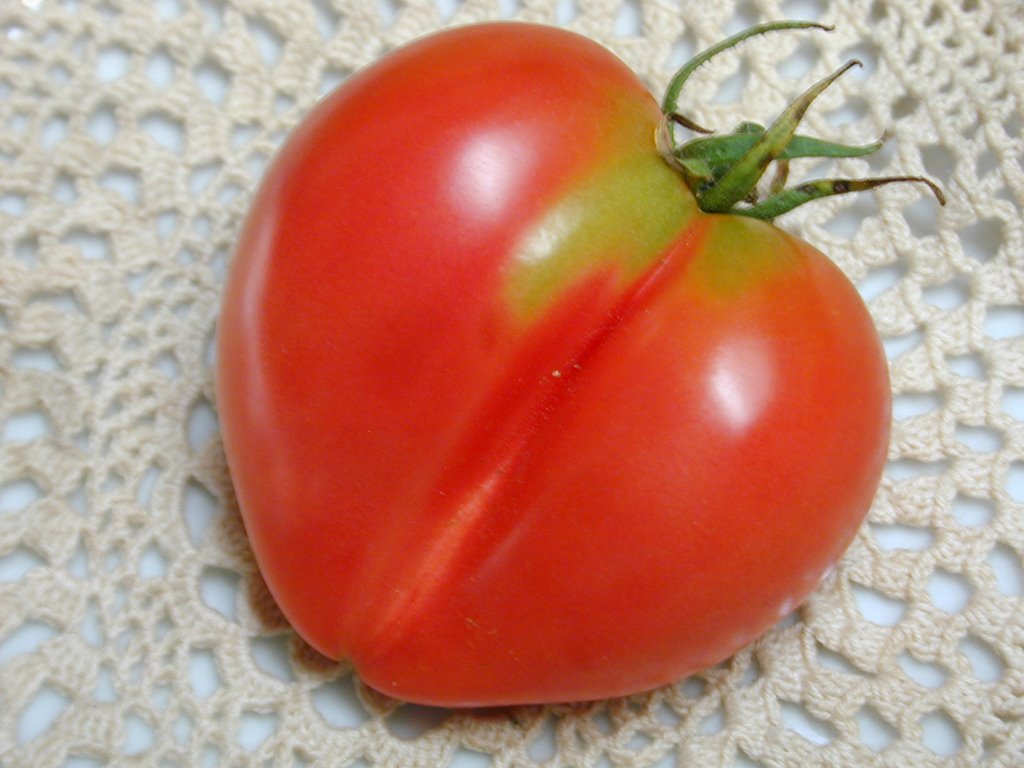 If I could only grow one thing in my garden, it would be tomatoes. I've been eating them everyday for the last few weeks and also giving many away. Last night I picked about 12 lbs and made them into sauce to freeze. This year I've planted 50 plants in 14 varieties. Some of the heirlooms like Brandywine and the purples aren't quite ready yet. If I could only plant one type, I'd actually have to choose Early Girl for it's good taste, good and early yield and medium size. I really like Brandywine too but it is a late tomato in my garden. I'm also really enjoying Sungold a lot. It's an orange cherry tomato. I thought I only liked red tomatoes, but Sungold has changed my mind. The varieties that I planted this year are;
betterboy
black prince
brandywine
cherokee purple
costoluto fiorentino
earlygirl
matts wild
old german
ox heart
parks whopper
unlabeled mystery (turned out to be a medium orange tomato)
sungold
supersonic
sweet100

Sunday, August 06, 2006
Spigariello
Today is Weekend dog blogging over at Sweetnicks. Check it out
 Spigariello in the field (no the dog is not named spigarello)
  Spigariello with some of today's harvest
  Spigariello serving suggestion (just kidding. It needs cooking. )
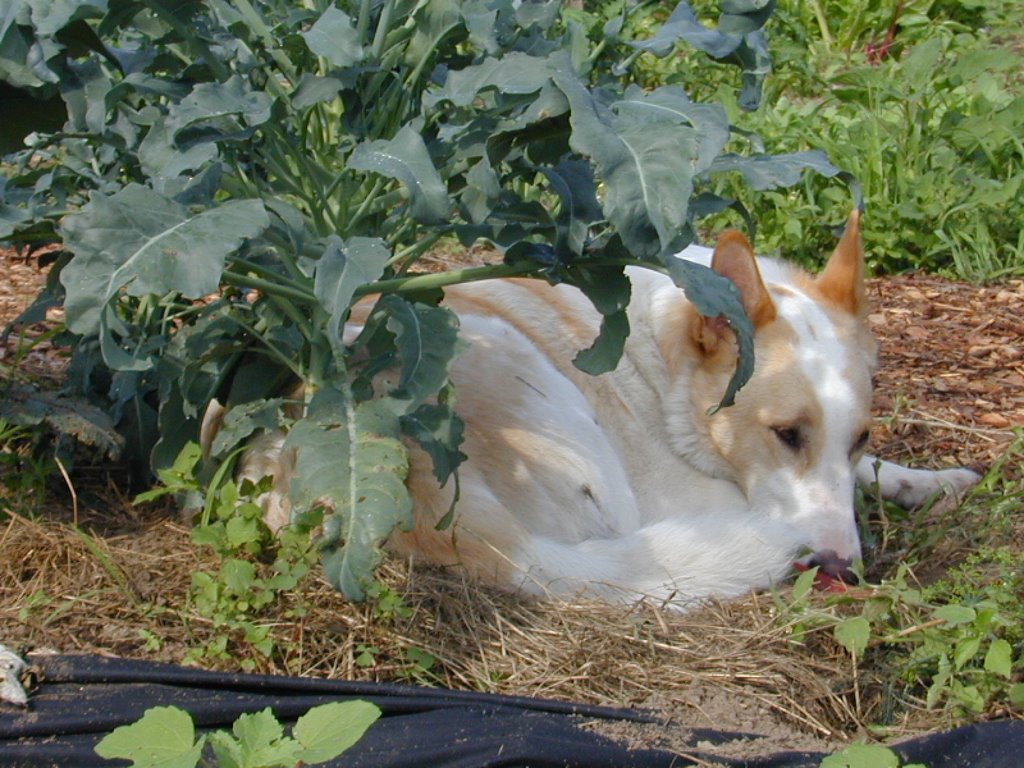 Spigariello in the field (no the dog is not named spigarello)
 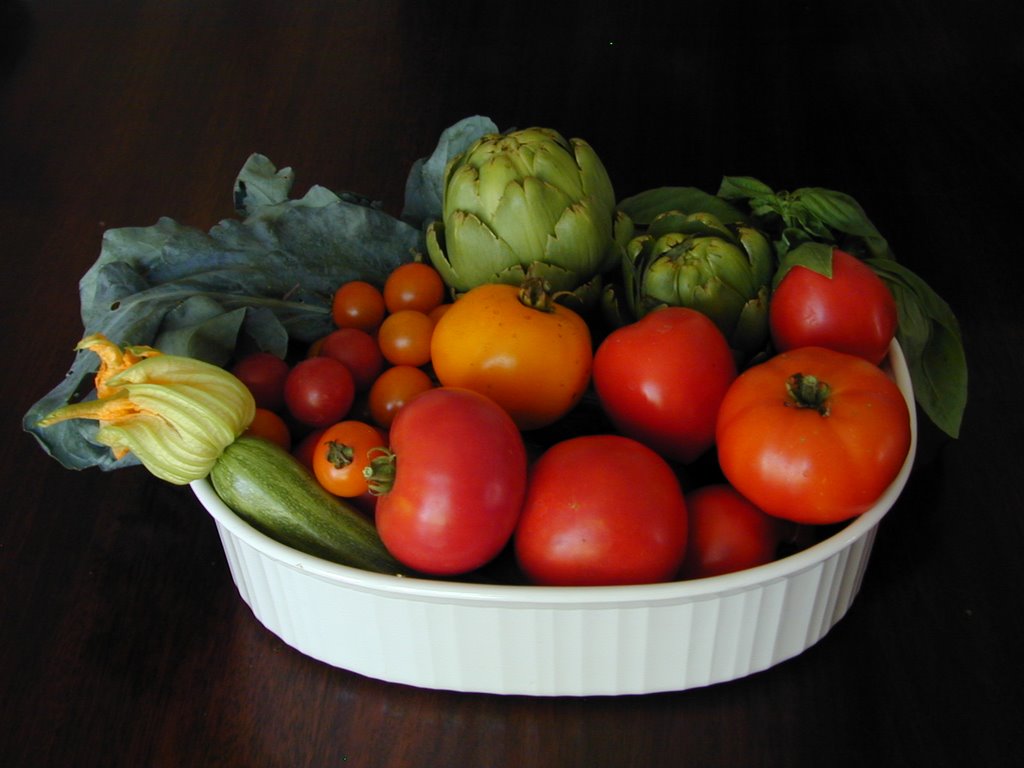 Spigariello with some of today's harvest
 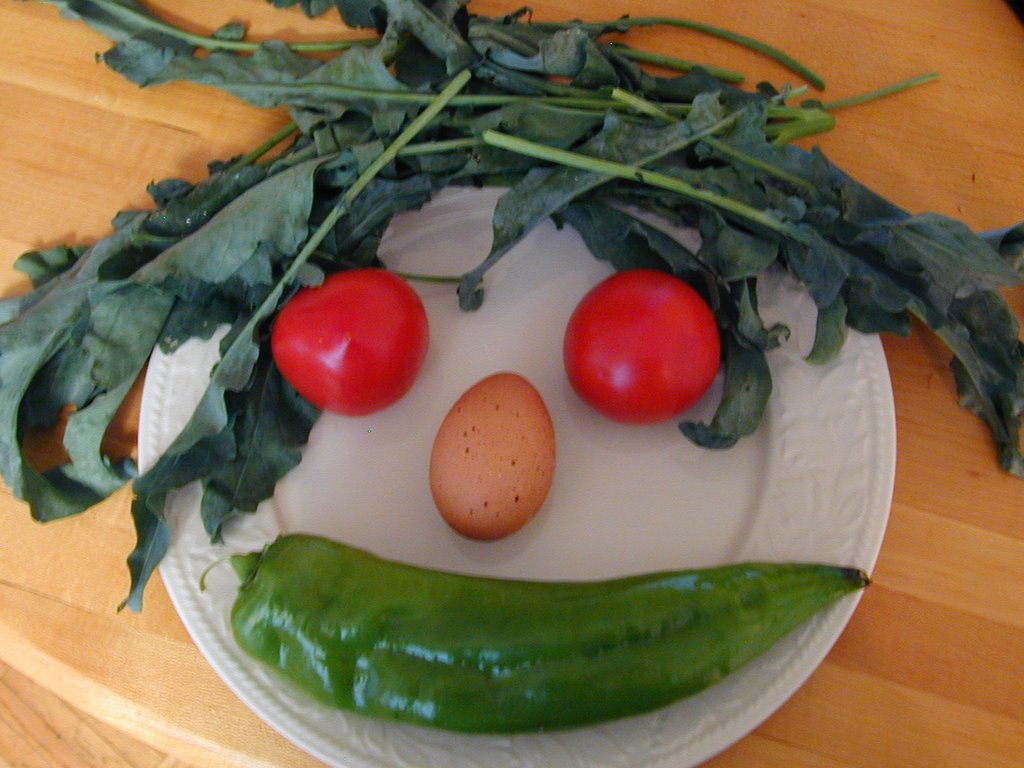 Spigariello serving suggestion (just kidding. It needs cooking. )
 Spigarello is a new vegetable for me this year. A friend gave me some seeds and I tried them even though I'd never actually eaten spigarello before. It turned out to be easy to grow and tasty. I planted it the same time as I planted broccoli. For cooking separate the leaves and stems and only cook the leaves. The stems are too tough to bother with. To me it tastes kind of like kale, but also with a definite broccoli taste. It is supposed to form little florets, but mine didn't. I'm guessing that might be because it's been too hot. I'm planning on freezing any extra I have for winter soups and growing it again next year. In the meantime it's been producing for weeks.
Monday, July 24, 2006
Zucchini
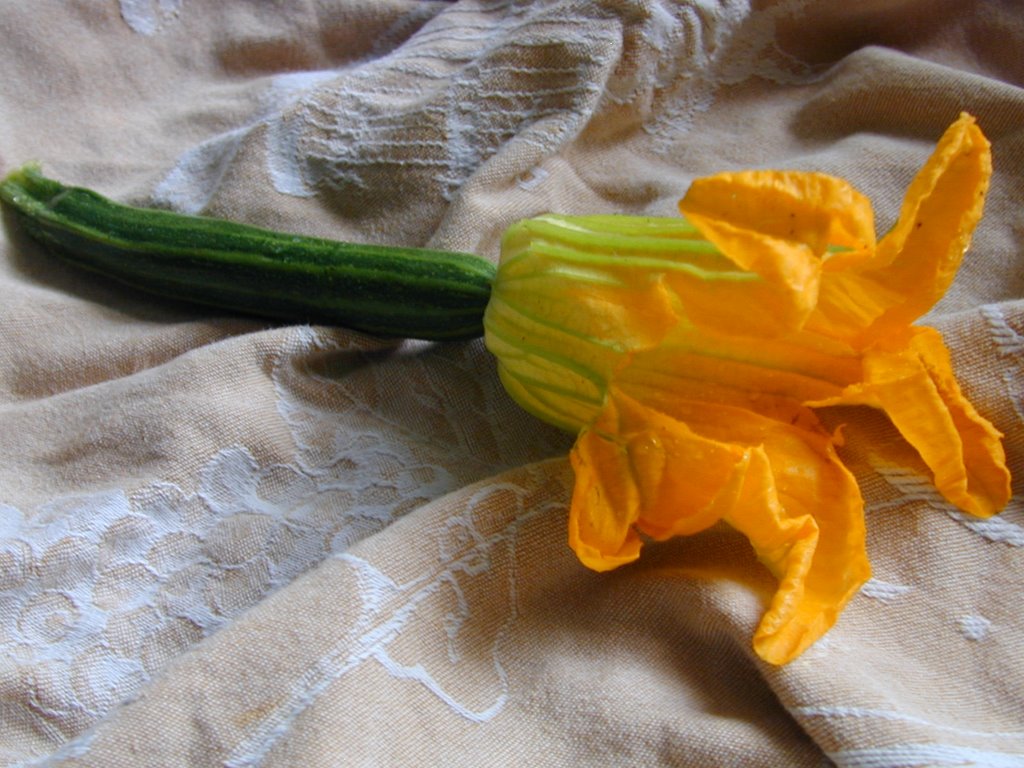
 The homegrown food for today is zucchini.
Home grown zucchini, like Rodney Dangerfield, seems to get no respect. It’s the butt of jokes and people act like it’s harder to give away than a litter of kittens. It does have a habit of hiding under its leaves and growing too big which is a shame because, in my opinion, size DOES matter. Smaller is better for zucchini. I like zucchini best about an inch in diameter. Bigger zucchini can be used for zucchini bread. I also sometimes make a casserole of zucchini, mozzarella, breadcrumbs and tomato sauce with zucchini up to 2 or so inches in diameter, but my favorite zucchinis are the very little ones that are smaller than are available in stores in the USA.
I picked my first zucchini this weekend. It was even smaller than the one inch diameter size I prefer, but you know how it is with zucchini, if you look away for a moment, it may double in size, so I grabbed it while it was still small. I decided to stuff the flower with a mixture of some feta, breadcrumbs and milk, then dipped it in egg and fried it. I would have preferred goat cheese for the stuffing, but had none. The zucchini I simply sliced and sautéed for a few minutes in olive oil. Together with some sliced tomatoes, it was a nice lunch.
Stuffed zucchini blossoms are a great way to use the flowers, especially the male blossoms that aren’t going to form zucchinis anyway. Just be sure to leave some male flowers on the plant so the female flowers can get pollinated. If you’re wondering which is which, the females have tiny zucchinis at the base of the flower. The males do not.
Variety: Franchi Seeds – Striato d’Italia ( Italian Striped)
I like this variety because it has ridges and nice flowers and of course because it tastes good.
Home Grown Dinner
I’ve decided to try and feature something I grow, catch, forage or harvest each day and see how long I can go with that theme. I’ll certainly interrupt the theme if a wild turkey plops itself in front of my camera and sits still or something interesting happens that I actually get a photo of, but I am curious just how many things I actually do grow and how long I can go with this theme.
Today’s feature was to be spigariello, but I’ll save that for another post because the photo does not do it justice. Today’s post instead will be the medley of the home grown dinner that includes the spigariello.
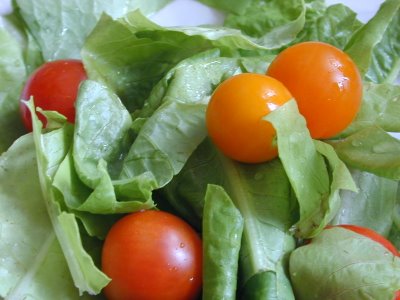
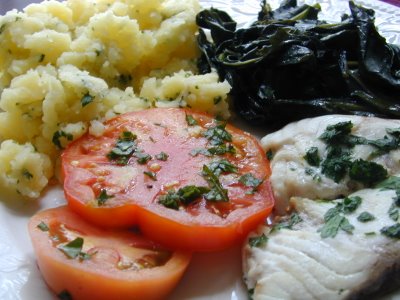
Everything on my dinner and salad plate I grew or caught, except for some butter, olive oil and salt which you can’t actually see, but it’s there improving what already tastes good. I enjoy and have lots of fun with the challenge of cooking meals mostly from things I grew, or in this case caught also. It’s kind of like a game for me to fashion a meal from what I can get from the garden or raise. I’ve added the categories of catching or foraging, because it’s my game so I can make up the rules. What you see some is of the striped bass that I froze after the Boston Harbor fishing expedition baked with a little butter and parsley, the first garden tomatoes with olive oil, basil and salt, and spigariello, boiled and then sautéed in a little olive oil. The spigariello is not actually as dark as it looks the photo. At the top of the plate is my favorite part of this meal. It's new Yukon Gold potatoes mashed with butter in which sage has been sautéed. The salad plate consists of romaine lettuce and a few Sweet 100 and Sungold cherry tomatoes, dressed with a little olive oil and salt. What follows is the recipe for the potatoes, It's so simple that it's really more of a concept than a recipe
Recipe: Potatoes with sage butter.
Boil some potatoes. Remove the skins.
Melt some butter in a sauté pan.
Chop up some fresh sage and sauté it in the butter for a few minutes until the butter just begins to start getting brown, but doesn’t actually turn brown. This will infuse the butter with the sage flavor.
Add the butter and sage mixture to the potatoes and mash.
Add salt to taste.
I purposely left the amount of sage butter to use out of this recipe. It’s a matter of taste and conscience. I used about a tablespoon of butter for one serving and it seemed right to me. I swear it tastes even better with new freshly dug potatoes, but it’s actually good with any old potatoes you may have around.
Today’s feature was to be spigariello, but I’ll save that for another post because the photo does not do it justice. Today’s post instead will be the medley of the home grown dinner that includes the spigariello.
Everything on my dinner and salad plate I grew or caught, except for some butter, olive oil and salt which you can’t actually see, but it’s there improving what already tastes good. I enjoy and have lots of fun with the challenge of cooking meals mostly from things I grew, or in this case caught also. It’s kind of like a game for me to fashion a meal from what I can get from the garden or raise. I’ve added the categories of catching or foraging, because it’s my game so I can make up the rules. What you see some is of the striped bass that I froze after the Boston Harbor fishing expedition baked with a little butter and parsley, the first garden tomatoes with olive oil, basil and salt, and spigariello, boiled and then sautéed in a little olive oil. The spigariello is not actually as dark as it looks the photo. At the top of the plate is my favorite part of this meal. It's new Yukon Gold potatoes mashed with butter in which sage has been sautéed. The salad plate consists of romaine lettuce and a few Sweet 100 and Sungold cherry tomatoes, dressed with a little olive oil and salt. What follows is the recipe for the potatoes, It's so simple that it's really more of a concept than a recipe
Recipe: Potatoes with sage butter.
Boil some potatoes. Remove the skins.
Melt some butter in a sauté pan.
Chop up some fresh sage and sauté it in the butter for a few minutes until the butter just begins to start getting brown, but doesn’t actually turn brown. This will infuse the butter with the sage flavor.
Add the butter and sage mixture to the potatoes and mash.
Add salt to taste.
I purposely left the amount of sage butter to use out of this recipe. It’s a matter of taste and conscience. I used about a tablespoon of butter for one serving and it seemed right to me. I swear it tastes even better with new freshly dug potatoes, but it’s actually good with any old potatoes you may have around.


Monday, July 10, 2006
Fava Beans
 After seeing a friend in Vermont grow fava beans a few years ago, I decided that I'd give them a try. Fresh fava beans are not often available in the store and I really like them so I figured why not grow my own. They are a cool weather crop and should be planted in Massachusetts as soon as the soil can be worked in the spring. I started mine indoors because the place I garden is often wet in the spring and doesn't get plowed until late. This year it was plowed early. I transplanted my seedlings and then it turned cold and very windy and we had record rainfall. The seedlings simply disappeared. I'm not sure whether the rain rotted them or the wind dried them up. About a month ago one weak little plant reappeared, or more likely grew from one of the original seeds that didn't germinate at the time of transplanting. What you are looking at in the photo is my entire fava bean crop of 2006 - one little plant with one little pod. I'm not giving up on favas. I hope to try them again next year.
Saturday, July 01, 2006
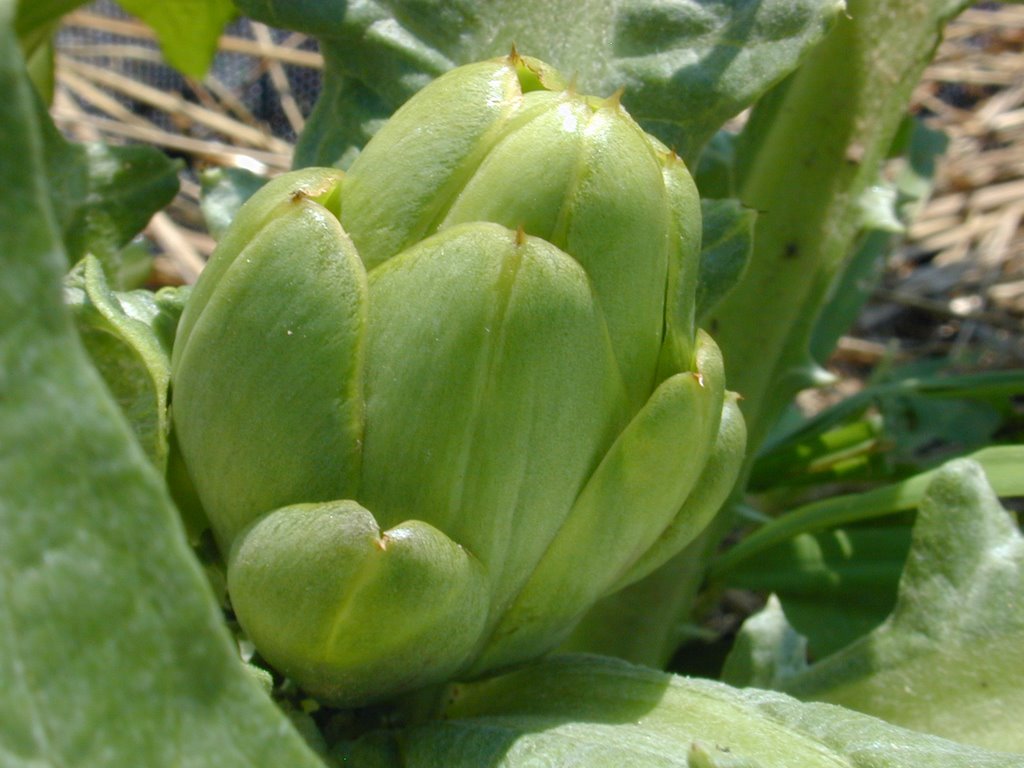
Artichokes Day 118
I wasn't sure I'd ever see a bud on my artichokes, but one of the artichoke plants has just formed a bud. It's still very small even though it looks huge in the first photo. This is the first year I've ever tried artichokes. Although artichokes are certainly not a typical Massachusetts crop, I've seen them in other's gardens that know that it is possible. The plants must be tricked into thinking that they are in their second year when they are only really in their first year. Apparently this one has been fooled. You can see previous photos of the artichoke sprouting, on day 20 and on day 57 if you'd like to follow its progress. If I actually get to eat one of these artichokes this year I'll create a post of exactly the steps I followed.



Thursday, June 29, 2006
One Fish, Two Fish, Striped Fish, Blue Fish
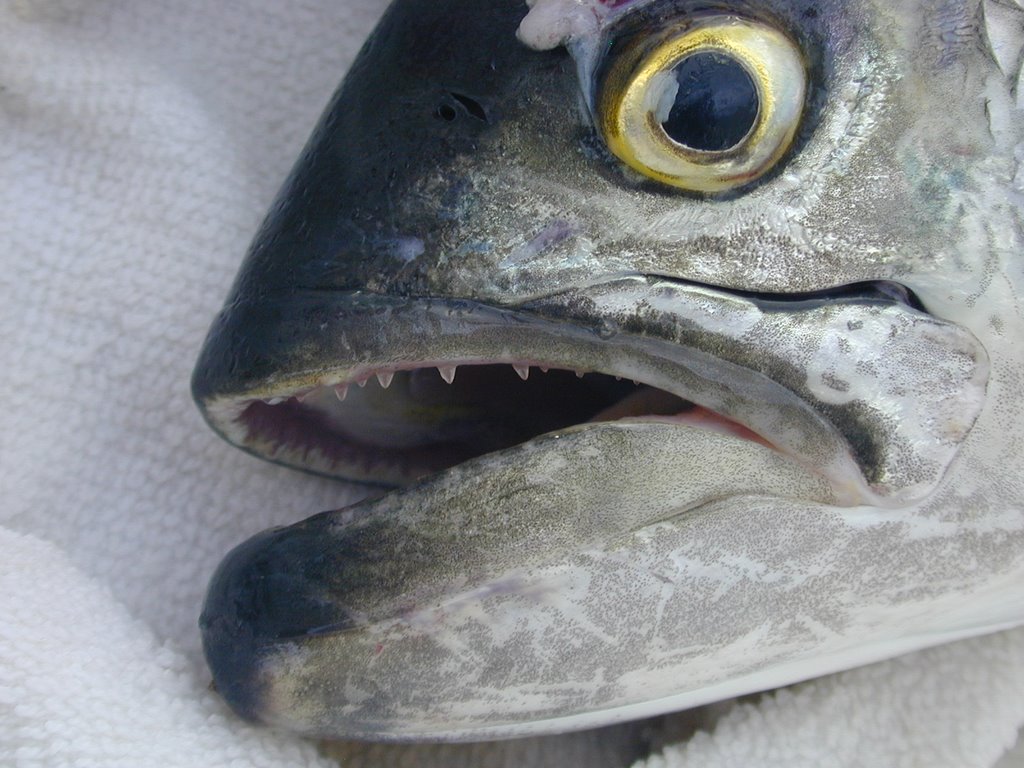
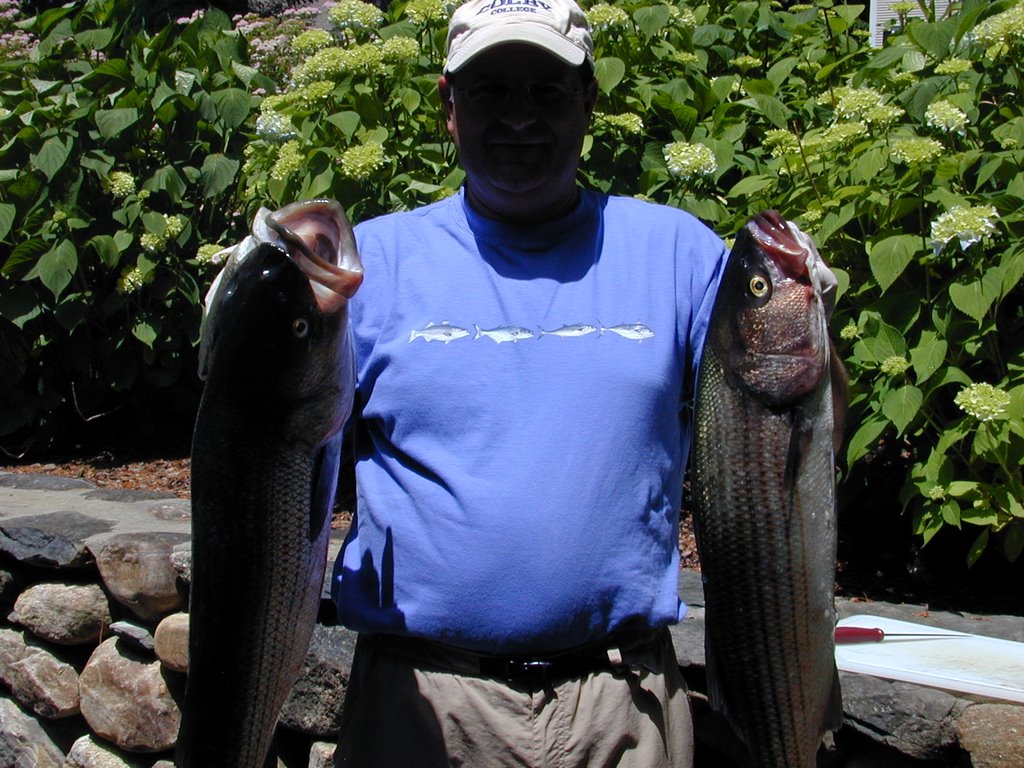
I don’t know where the time goes. Lately, each day it seems I run out of time before I get a chance to blog., too much work, too many weeds, too much rain. Tuesday was a workday but I skipped out of that, got up at the ridiculous hour of 4 am and I went fishing with my brother. I was lucky and that night got to have fish for supper. Outside of sand sharks these were the largest fish I’ve ever caught. I won’t say how large because they seem to continue to grow larger and larger with each telling of the story. You can see for yourself below in a photo of my brother holding the two striped bass that I caught that were keepers and a closeup a bluefish I caught who is giving me the evil eye. I was so tired from getting up at 4am that I just baked the striped bass with a little butter and didn’t do anything fancy to it. It was yummy, but if I hadn’t been so exhausted I’d have headed over to Beyond Salmon to get a more interesting recipe. I gave some away and froze the rest of the filets. I really have little experience freezing fish and am curious to see what it tastes like in a few weeks after it has been in the freezer.


Friday, June 16, 2006
A Tomato is Born
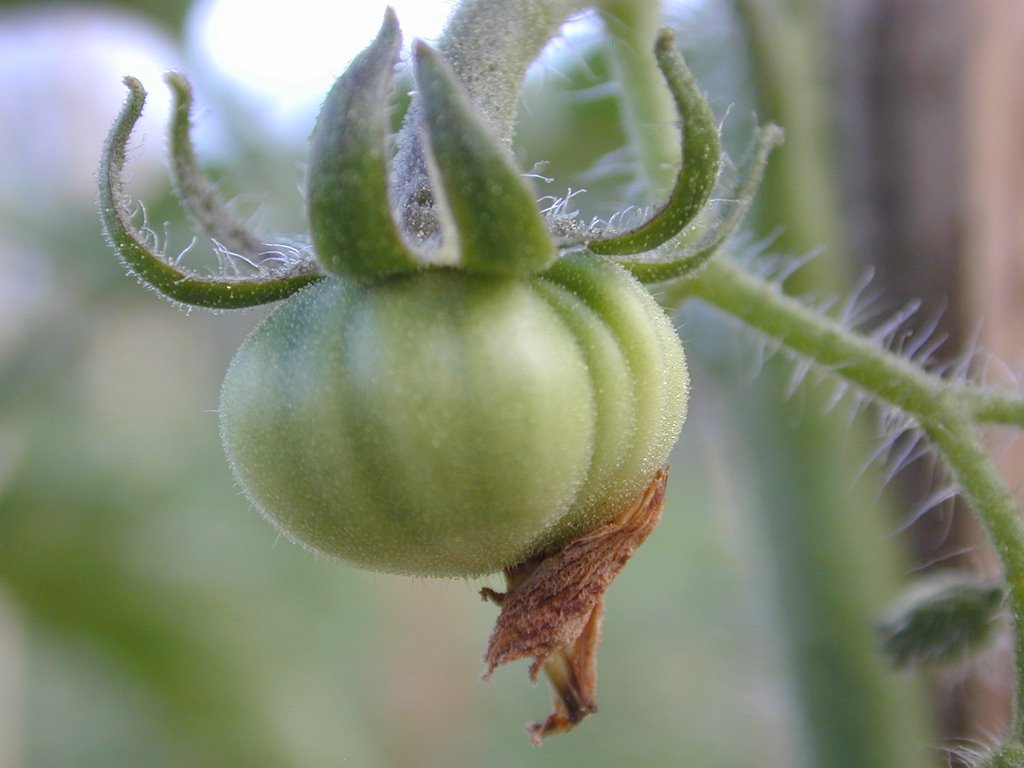 If I could only plant one thing in my garden it would be tomatoes. Today I discovered the first tomato fruits starting to grow. They are both so young that their flowers haven't even fallen off yet. They are nowhere as big as they look, are pea-sized and barely noticeable if you walk in the garden. The one above is a Costoluto Fiorentino. It's one of the varieties that I grew from seed. and is a new one for me this year. It's described as a big, old-fashioned, misshapen, heavy, ribbed beef tomato from Florence, very meaty and ideal for slicing with fruits about 5 or 6 ounces. Its heavy ribs are certainly evident even so soon after planting.
Below is a very young, also pea-sized cherry tomato. The variety is Matt's Wild Cherry. I planted this variety last year. Its a good tasting prolific small red cherry tomato. It is one of the most tenacious tomato varieties I've ever planted. When other tomatoes are being attacked by blights and other things this variety kept going strong and it's doesn't seem prone to cracking. When I discovered cherry tomatoes in a row where I knew that I had not planted any cherry tomatoes it was always this variety. It ranges every where. It is the exact opposite of compact and bushy. It has a lot of personality. I always thought it would be a great tomato to train on an arched arbor. I like this tomato a lot but now plant it on the ends of the rows where I can keep a close eye on it. The fruits are small, tomato red and are perfect for adding to salads or eating as you work in the garden.

Saturday, June 10, 2006
Too Much Rain

Middlesex county in Massachusetts where I live was declared a federal disaster area May 12th due to flooding and it's been raining even more since then. I've planted green beans twice, chard and zinnia seeds, but haven't seen any sprouting in a few weeks and think they have rotted. It's just too cool and wet. For some reason the winter and summer squash have actually sprouted. The tomatoes and peppers that were planted as seedlings are hanging on, but not really growing much in what seems like endless cool wet weather. Even though I planted my potatoes in a trench they are looking OK and haven't been attacked by Colorado beetles yet. Lettuce is the one thing that really seems happy, but even lettuce is looking a bit pale due to lack of sun. I took this photo at Codman Farm in Lincoln MA where I have my community garden. I remember it was taken on one of the few sunny days this spring and was unseasonably hot. These three ducks had found a little shade and were relaxing the afternoon away. The way one of them has his mouth open it looks like the are all having an afternoon conversation. Everyone I talked to is really tired of all the rain, mud and flooding, but these three fellows are probably rather happy with the very unusual spring weather we are having.
Subscribe to:
Posts (Atom)